A First Visit to a Stadium District on a Quiet Day
A quiet-day stadium district walk reveals how ordinary neighborhood routines, public routes, and small daily destinations connect beyond the venue.
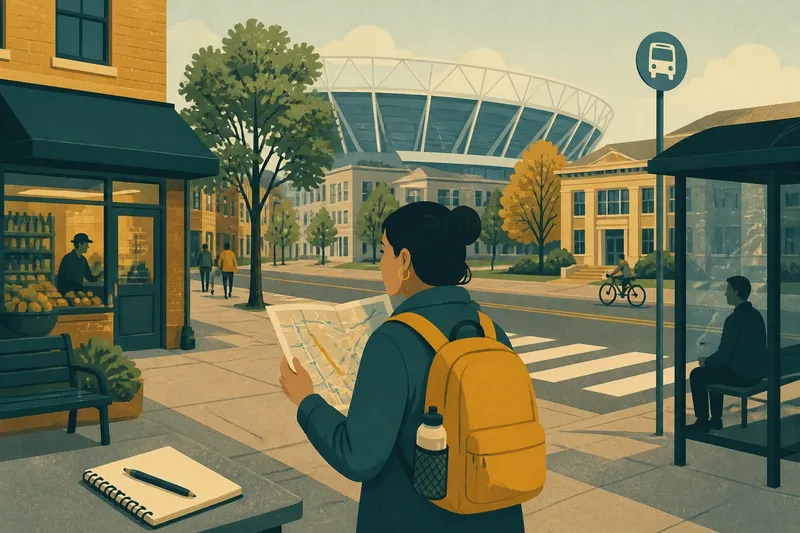
A quiet-day stadium district walk is most revealing when you follow an ordinary errand, not the route to the front gate. A bus stop, corner store, library, or lunch counter shows whether the surrounding streets serve people when no event is calling them there.
Say Maya is visiting a city and has an afternoon free near its football stadium. She starts at a transit stop with a paper map and plans to find a place for a snack, then return by a different public street. Her field note will record what the neighborhood lets her do between those points, not just what the stadium looks like.
Choose an everyday purpose
A small purpose gives the walk a useful frame. Maya picks up a snack and looks for a public place to sit. Someone else might be heading to a library, waiting for a bus, or walking between a residential block and a neighborhood shop. These routines reveal how the district works at street level without requiring access to the venue.
Before setting out, Maya checks a city map for public streets and sidewalks connecting the transit stop with the shop. She marks a possible return route, but leaves room to change course if a sidewalk is closed or access is unclear. The stadium is a landmark along the way, not permission to enter its grounds.
She writes down the starting point and her intended errand. That small note helps distinguish places she actually encountered from destinations that merely appeared on the map.
Record neighborhood routines
As Maya walks, she notes what people can do from the public street: wait at a bus shelter, enter a shop, sit on a bench, or continue toward homes and other civic places. She does not infer who lives nearby or why a particular entrance is open. The observation stays with visible uses and public access.
She also notices the rhythm of the block. A grocery with a visible entrance offers a different kind of street activity from a long service wall. A bus stop may connect the venue district to places beyond it, while a library or school gives the street an everyday destination unrelated to stadium events. These details make the field note about the neighborhood rather than a survey of the building’s edges.
Imagine Maya reaches a corner store, but the sidewalk beyond it is closed for maintenance. She records the closure, buys her snack, and takes the mapped public street back toward the transit stop. The result is a note that identifies both an everyday destination and a limit on the route, without treating the obstruction as an invitation to find a way through.
Build a useful field note
A compact note works best when it separates observation from interpretation. Maya records the route she took, the errands or public amenities she encountered, and one change in the street’s character. If she cannot tell whether a signed path is normally open, she marks that as an unanswered question instead of guessing.
- Check whether the starting point is a public transit stop or street; if it is public, begin there, and if not, choose a nearby public location.
- Check the map for a public sidewalk to the intended everyday destination; if the route is shown, follow it, and if it is unclear, choose a street with visible public access.
- Check whether a shop, library, or other destination has a visible public entrance; if it does, note its use, and if it does not, record only what can be seen from the sidewalk.
- Check whether a bus stop or bench is accessible from the public route; if it is, note how it serves the block, and if access is blocked, continue without crossing a barrier.
- Check whether street activity changes between the stadium and nearby homes or civic places; if it does, name the visible change, and if it does not, describe the continuous street use.
- Check whether a closure or access rule is posted; if it is, follow it and use another public street, and if the status is unclear, leave the area and verify it through an official source.
Use plain descriptions rather than conclusions: “The corner store is open to the sidewalk; the bus shelter is across the street; the route toward the library continues on the public sidewalk.” A few accurate details are more useful than a verdict about whether the district feels lively.
Questions for the walk?
What counts as an everyday destination?
Look for places used beyond stadium events, such as a grocery, library, bus stop, school, or residential street. Record only the visible use; a closed door does not explain who may enter or when.
How should I note an uncertain route?
Write down where the public sidewalk ends or where access signs become unclear. Take another public street rather than crossing a gate, parking entrance, or service area.
What should a field note include?
Include the starting point, the route actually taken, one everyday destination, and a visible change in street use. Add any unresolved question separately so an observation does not quietly turn into an assumption.
Keep the claim narrow
Maya’s finished note might say: “From the transit stop, I followed the public sidewalk past the stadium and bought a snack at the corner store. A bus shelter sits across the street, and the route toward the library continues along a residential block. A maintenance closure prevented the planned return on the same side, so I used the next public street.” Those details describe the walk she made, not every way the district operates.
A quiet-day stadium district walk can show how a particular stretch of city supports ordinary errands and movement. It cannot establish what happens during an event or explain activity beyond the places visible from public space. Keep the route, the observed uses, and the unknowns distinct; that is what makes a brief field note useful later.