Named Gate or Numbered Gate? Two Ways to Organize Arrival
Named or numbered stadium gates: choose a system that helps visitors identify the right entrance, describe it clearly, and reunite without confusion.
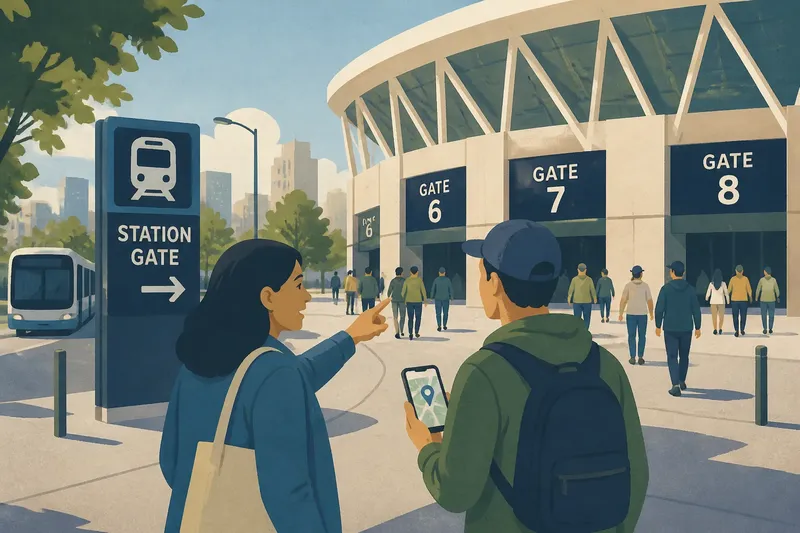
Named or numbered stadium gates work best when their labels match the way visitors describe a destination. A gate called “North” is easy to discuss if the stadium has a clear north side; a gate marked “12” is easier to find when tickets, maps, and signs all use that number.
The choice is not simply between friendly names and tidy digits. It is between two kinds of reference: one tied to place, the other to an ordered label. Stadium operators should choose according to how people arrive, what information they receive, and how reliably they can pass directions to someone else.
Choose names for places
Names help when an entrance has a recognizable relationship to its surroundings. “River Gate,” “Market Street Entrance,” or “East Gate” can connect the stadium to a street, a neighborhood, a transit stop, or a familiar direction. The label gives visitors a verbal landmark rather than a code to remember.
This works particularly well when several groups are coordinating from different starting points. Someone arriving by bus can say, “Meet at the Market Street Entrance,” while a companion walking from nearby shops can follow the same place-based cue. A name can also make a public entrance feel like part of the city rather than a service door in a large structure.
Names become less useful when they imply a distinction visitors cannot see. “Garden Gate” is a poor locator if the garden is hidden behind the building, and “North Gate” invites confusion if the approach roads make north hard to judge. A memorable label is not the same as a legible one.
Use names when the entrance has a stable, visible landmark that people already recognize.
Choose numbers for systems
Numbers suit buildings with many entrances, repeated concourses, or ticketing systems that already assign a gate number. A number can be concise on a ticket, easy to display on a sign, and straightforward to sort in a venue map. It avoids the need to invent a separate vocabulary for every doorway.
Numbering is strongest when it follows a pattern a visitor can understand. Consecutive numbers around the perimeter, for example, can make the next gate feel locatable rather than arbitrary. The pattern should be visible on maps and signs; a numbering logic known only to operations staff is not much help to someone standing outside in a crowd.
Numbers are also useful when entrances have similar surroundings. If several doors face a broad plaza with few distinct landmarks, “Gate 8” can identify one exact point more cleanly than a descriptive name that sounds much like the others. The number still needs to appear consistently in the ticket, map, and physical signage.
Use numbers when precision and consistency matter more than a place-based description.
Match labels to journeys
Start with the information visitors already have. If tickets name an entrance, that exact label should be prominent on the approach signs. If the venue map uses a name but the door carries a number, visitors must translate between systems while moving through a busy public space. That translation is needless work.
Then consider how people will explain the destination aloud or by message. A name can be easier to remember; a number can be easier to distinguish. Neither advantage survives if the label is hard to pronounce, hard to see, or repeated at another entrance.
- Several distinct street approaches: Use names tied to streets or familiar landmarks, so directions describe the route as well as the door.
- Many similar entrances: Use numbers with a visible, consistent order, so each doorway has a distinct label.
- Tickets already specify a gate: Keep that gate label unchanged across maps and signs, so visitors can match one source to another.
- Groups meet from different directions: Favor a name linked to a shared landmark, unless the number is already the venue’s common meeting reference.
- Entrances change with event operations: Prefer labels that remain stable, or make temporary closures and alternative entrances explicit on every visitor-facing channel.
Can names and numbers coexist?
Can a gate have both a name and a number?
Yes, if one label is clearly primary and the other supports it. “Market Street, Gate 4” can connect a familiar place to an exact entrance, but signs should not alternate between treating the name and number as the official label.
Which label is easier to remember?
That depends on what visitors can see and what they have been told. A distinctive landmark name may stick better than a number, while a number printed on a ticket may be easier to recall than a newly coined name.
What if a gate serves more than one arrival route?
Use the label that identifies the destination consistently, then add route directions where visitors make a choice. A gate name should not be expected to explain every way to reach it.
How should a closed entrance be described?
Keep the usual gate label visible in the closure notice and name the alternative entrance directly. Visitors need to understand both what has changed and where to go instead.
Keep directions sayable
A useful label passes a simple conversation test: can one person say it once, and can another person identify the right entrance without asking what the label means? If not, the problem may be the name, the numbering pattern, or the signs connecting that label to the physical place.
Say you are assigning labels to a stadium with one entrance beside a recognizable transit stop and several similar doors along a service road. Naming the transit-side entrance “Station Gate” gives arriving companions a shared landmark; numbering the similar doors gives them distinct destinations. The expected result is that visitors can use a place cue where one exists and an exact identifier where it does not, rather than forcing one system across unlike approaches.
For a stadium deciding between named or numbered gates, the practical test is whether the label survives a handoff: from ticket to map, from map to sign, and from one person’s directions to another person’s arrival. Keep the system that makes that handoff plain, and resist adding a second label unless it genuinely helps someone find the door.