From Open Ground to Enclosed Bowl: A Short History of Stadium Form
Stadium form shaped how crowds experienced events, from open grounds to enclosed bowls. Learn to read what stands, gaps, and sightlines reveal about a venue.
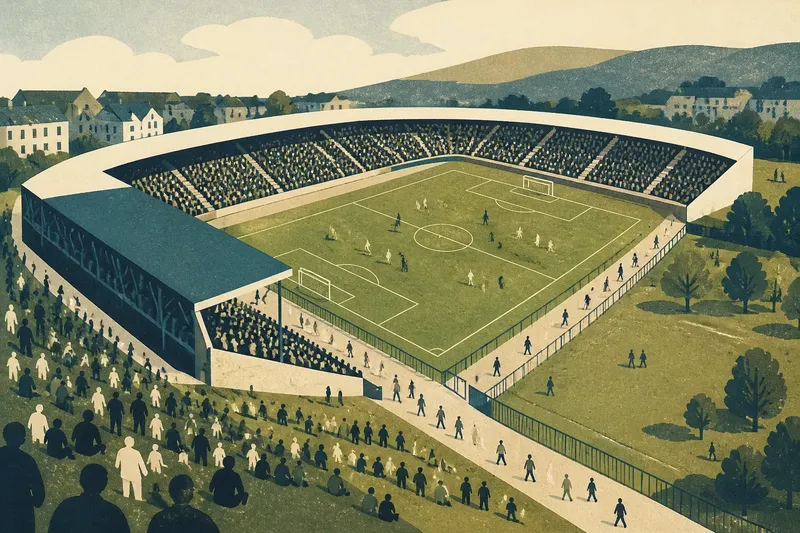
Stadium form shapes where spectators look and how they experience a crowd. From an open field with a single stand to a bowl enclosed by seating, each arrangement gives the event a different frame.
These forms did not replace one another in a tidy sequence. Open grounds, temporary stands, racecourses, and purpose-built venues have coexisted; their layouts reflect different sites and uses. Rather than treating the enclosed bowl as the inevitable end point, it is more useful to ask how each form places the audience in relation to the event.
Open ground seating
An open ground leaves much of the audience’s position to the site. Spectators may gather along a boundary, stand on a slope, or use temporary platforms. The playing area is the main fixture; the spectator edge can remain informal or change between events.
That arrangement keeps the event visually connected to its surroundings. A spectator may see landscape or nearby streets beyond the field, while people outside the gathering may still sense the activity. Fences and ticket controls can create limits, but the spectator space does not necessarily read as a complete room.
Freedom of position also brings uneven views. A raised bank may offer a clear sightline, while a flat edge behind a crowd may leave a spectator looking at shoulders. An open layout lets people shift about, but it offers less control over where they end up.
Stands define the edge
A permanent stand makes the spectator’s position more deliberate. Rows of seats direct views toward the event, while terraces and banks organize people into larger groups. The structure does more than mark the edge of the ground: it sets out where the audience is expected to gather.
With a stand on one side, spectators form a concentrated line beside the event. Seating on several sides makes the audience more present across the field, though gaps may still leave the setting open. The difference is not only how much seating exists. It is whether the crowd appears beside the event or gathered around it.
From the field, a stand can make the crowd a visible backdrop. From the seats, the event has a more deliberate frame. Neither arrangement ensures a good view from every place; distance, obstructions, roof coverage, and the angle of the seating still matter.
Enclosed bowl focus
An enclosed bowl organizes seating around the event, usually on most sides. Looking across the venue, spectators encounter other sections of the crowd rather than an open horizon. The audience becomes part of the setting, and attention is drawn inward.
This shape can make a gathering feel more collective. Crowd movement and reaction are visible across the venue, while the event occupies a defined center. The effect varies with the building: a roof, a corner gap, or a distant tier changes what spectators see and hear. “Bowl” describes a broad arrangement, not a promise of identical experience from every seat.
Enclosure also gives the venue a clearer interior. Entrances, circulation routes, seating tiers, and the event area fit within a more legible boundary. That can focus attention, but it also directs the audience more firmly than an open field does.
Reading stadium form?
What makes a stadium an enclosed bowl?
A bowl has seating on most sides of the playing or event area, creating an inward focus. It does not need a roof or a completely unbroken ring of stands.
Why add permanent stands?
Permanent stands establish lasting spectator positions and organize sightlines toward the event. They also make the audience’s location part of the venue’s fixed layout.
Did open grounds disappear?
No. Open grounds and partial enclosures remain useful when a site or event calls for flexibility. Many venues combine enclosed sections with open edges or gaps.
How does a bowl affect the crowd?
It places spectators in a more visible collective setting, with people facing the event and often seeing other sections across it. The tradeoff is a more directed, bounded audience space.
Why forms persist
Open grounds, partial enclosures, and bowls serve different purposes. Temporary seating can define a view without making the whole site permanent. A venue with open corners or separated stands may retain a connection to nearby streets, landscape, or a site boundary; the gap alone does not reveal why it was left.
Imagine a town has a level field, a temporary stand along one touchline, and open land beyond the opposite side. If the town adds permanent stands on two more sides, spectators would be able to see the crowd across the field, and the event would have a stronger visual boundary. The remaining open side would still frame the surrounding land, so the result would be more enclosed without becoming a complete bowl.
When looking at stadium form, note where the audience sits, what spectators can see across the venue, and whether the surroundings remain in view. A continuous ring, a lone stand, and an open corner each show a different way of arranging the crowd. A gap can be as informative as a completed enclosure: it tells you where the venue leaves the outside world in the frame.